
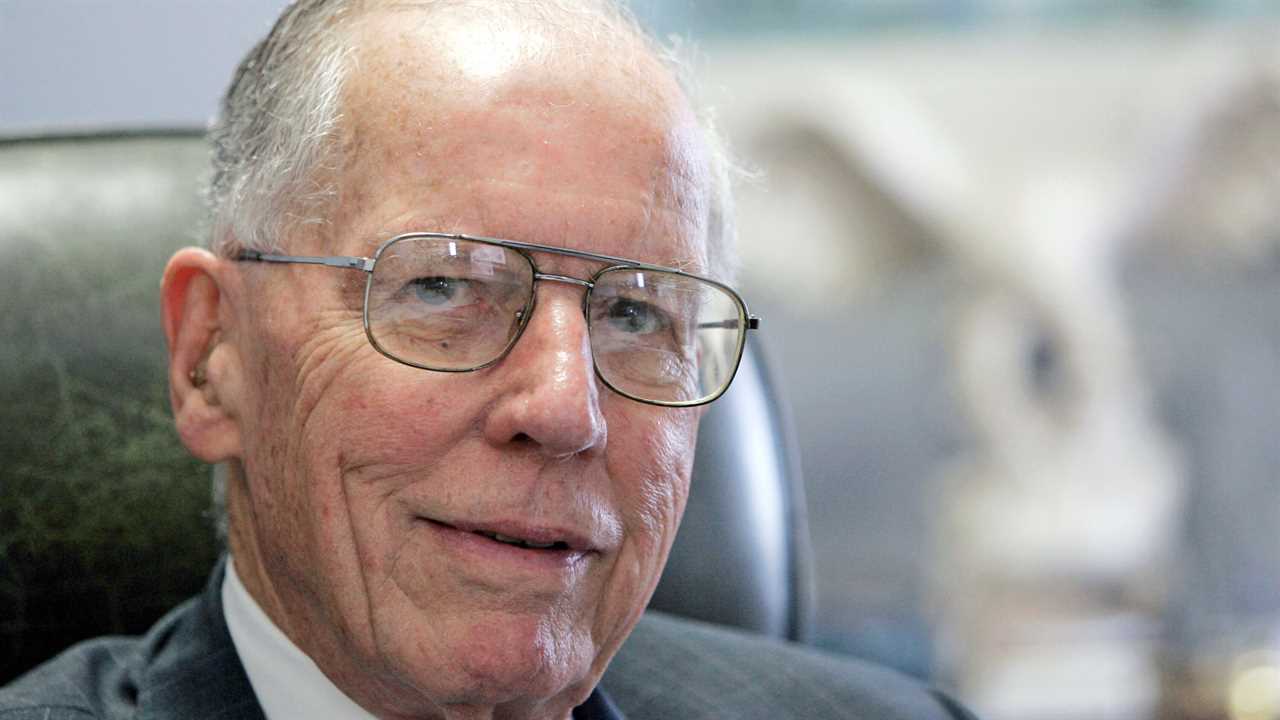
William F. Winter, a Mississippi politician who stood athwart the racism of many of his fellow white Democrats during the civil rights era and used his single term as governor to address injustice in the state’s education system, died on Friday at his home in Jackson, Miss. He was 97.
His death was confirmed by Dick Molpus, a family spokesman and former aide.
Mr. Winter first ran for office in 1947 while still a law student at the University of Mississippi, capturing a seat in the State House of Representatives. He appeared on various ballots every four years for the next four decades, making his name more for the positions he took on integration and good government than for his record at the polls. He ran for governor twice before finally winning, in 1979.
At the time, Mississippi’s governors were limited to a single term, and Mr. Winter was determined to make the most of his. He had run on reforming the state’s dismal education system: Mississippi was the only state without public kindergarten, and it was the only state without funding for compulsory public education, a vestige of its extreme reaction to the Supreme Court’s 1954 decision striking down school segregation.
Mr. Winter found legislative progress as elusive as electoral success. His first two attempts at getting an education reform bill passed failed, while public support was lukewarm at best. After their second try, in 1982, he and his aides doubled down, beefing up the bill with additional measures like depoliticizing the state board of education and raising teacher standards. He called for a special session that fall, with education the only item on the agenda.
Faced with intense opposition in the Legislature, Mr. Winter took to the road. He delivered 82 speeches supporting the bill, while his wife, Elise, and his aides made 532 more. He, his wife and his aides held nine enormous rallies around the state and coordinated his efforts with coverage by the editors of the state’s largest newspaper, The Clarion-Ledger, which won a Pulitzer Prize for its efforts.
By December, when the Legislature finally assembled to vote, public opinion had swung hard in Mr. Winter’s favor. The bill passed overwhelmingly in the House, and by a single vote in the Senate, on Dec. 20. The press called it “the Christmas miracle.”
“His work in education reform changed decades of policies that had ensured inferior education for children of color,” Marian Wright Edelman, the founder of the Children’s Defense Fund, said in a phone interview.
>
In 1984 Mr. Winter ran for the United States Senate — his Republican opponent was a friend, Thad Cochran — and lost. After that, he retired from electoral politics. But he remained active in public life, leveraging the good will he earned as governor into support for efforts around racial reconciliation, including a campaign to remove Confederate imagery from the state flag.
“He was the model of what you aspire to be as governor,” Ray Mabus, who worked in Mr. Winter’s administration and served as governor himself from 1988 to 1992, said in an interview. “He was the best governor Mississippi ever had.”
William Forrest Winter was born on Feb. 21, 1923, in Grenada, Miss., a small town in the north central part of the state. He grew up nearby, on a farm owned by his father, William Aylmer Winter, who served three terms in the State House of Representatives and three in the State Senate. His mother, Inez (Parker) Winter, was a teacher.
He is survived by his wife, Elise (Varner) Winter; his daughters, Anne Winter, Lele Gillespie and Eleanor Winter; five grandchildren; and five great-grandchildren.
Both Black and white tenants lived and worked on the Winters’ farm, and young William developed friendships with several Black children. But this was Jim Crow-era Mississippi, and the Winters were typical in their embrace of the state’s enforced racial hierarchy.
“All I knew growing up was racial segregation,” Mr. Winter said in an interview for the documentary “The Toughest Job: William Winter’s Mississippi” (2014). “It was an accepted way of life in the white community.”
Still, two experiences pointed Mr. Winter in a different direction.
In college at the University of Mississippi, he became friends with James Silver, a history professor whose progressive teachings on race and civil rights inspired a generation of liberal Mississippians.
After graduating in 1943, Mr. Winter entered the Army as an officer. An aspiring politician even then, he dreamed of a combat role, but instead found himself training a segregated Black regiment in northeast Alabama. There, as part of an experiment in integration, he worked alongside Black officers, whose talk about civil rights and political progress inspired him to push for change back home.
After the war, Mr. Winter joined a wave of young veterans, white and Black, who returned to the South committed to upending the political status quo. He was one of 12 law students at Ole Miss to run for office in 1946; 11 of them won.
He developed a reputation as an advocate for good government — in the 1960s, as the head of the state’s tax collection office, an infamously corrupt agency, he successfully called for its elimination. He also became known as a racial moderate, calling on the state to accept the inevitable end of Jim Crow. But in civil rights-era Mississippi, even moderation was too far for many whites, who attacked him as a dangerous liberal.
Mr. Winter made his first run at the governor’s office in 1967, taking on John Bell Williams, a sneering segregationist who defended the state’s policy of resistance to civil rights.
As he later recalled with great shame, Mr. Winter tried tilting to the right. At a forum hosted by the racist White Citizens’ Council, he said: “I was born a segregationist. I was raised a segregationist. I always defended that position. I defend it now.”
But his record said otherwise, and the Ku Klux Klan made him a target. Stuart Stevens, the Republican political strategist who as a teenager volunteered on that campaign, recalled standing with him outside a rally in Gulfport, Miss. Earlier in the day, an anonymous caller had threatened to kill Mr. Winter if he spoke that night. His aides told him not to. He went ahead anyway.
“It was the bravest thing I have ever seen in my life,” Mr. Stevens said. “Winter was someone who made you proud to be from Mississippi.”
Mr. Winter lost that race, and another run for governor in 1975 (though he did serve as lieutenant governor in between). Despite saying he was through with politics, he took one more shot at the governor’s mansion, in 1979, this time hiring professional pollsters and media operatives and hoping that the state’s politics had come around. He won handily.
Almost immediately, he set a new tone for state leadership. He and his wife held a series of dinners at the governor’s mansion featuring prominent Mississippians, and not just white people like Walker Percy and Eudora Welty. Myrlie Evers-Williams, the widow of the slain civil rights leader Medgar Evers, dined with them, as did Leontyne Price, the world-famous soprano whom previous governors had shunned. The Winters invited her to stay overnight in the Bilbo Room, named for Theodore G. Bilbo, an infamously racist governor and senator; the next day Mr. Winter renamed it the Leontyne Price Room.
>
“I have such respect for that man and actually love him,” Ms. Evers-Williams said by email. “He showed bravery in taking on issues that weren’t popular.”
After his failed Senate race, Mr. Winter threw himself into civil rights work: In 1995 President Bill Clinton named him to the National Commission on Race. Mr. Winter continued his efforts with the founding of the Institute for Racial Reconciliation at the University of Mississippi. It was later renamed the Winter Institute in his honor and became independent.
In 2001 Mr. Winter led an effort to remove the Confederate battle flag from the Mississippi state flag. A referendum on his proposal failed that fall, but he continued to push for the change.
Finally in June, nearly 20 years later and amid the summer’s outpouring of racial activism, the State Legislature voted to remove the emblem. It was a move that Mr. Winter welcomed, even as he warned, in one of his last public comments, that it was not enough.
“The battle for a better Mississippi,” he told The Associated Press, “does not end with the removal of the flag.”
Did you miss our previous article...
https://trendinginthenews.com/usa-politics/trumps-longtime-banker-at-deutsche-bank-resigns