The Republican-controlled Texas House of Representatives is poised to take up a bill on Sunday that would impose a raft of new voting restrictions in the state, moving a step closer to the expected full passage of what would be among the most far-reaching laws in Republicans’ nationwide drive to overhaul elections systems and limit voting.
The bill, which passed the State Senate early Sunday, would tighten what are already some of the country’s strictest voting laws, and it would specifically target balloting methods that were employed for the first time last year by Harris County, home to Houston.
In addition to banning drive-through voting and 24-hour voting, which were used by nearly 140,000 voters in Harris County during the 2020 election, the bill would prohibit election officials from sending absentee ballots to all voters, regardless of whether they had requested them; ban using tents, garages, mobile units or any temporary structure as a polling location; further limit who could vote absentee; and add new identification requirements for voting by mail.
Partisan poll watchers would also have more access and autonomy under the bill’s provisions, and election officials could be more harshly punished if they make mistakes or otherwise run afoul of election codes and laws.
The bill, which was hashed out in a closed-door panel of lawmakers over the past week as the spring legislative session neared its conclusion on Monday, was rushed to the State Senate floor late Saturday in a legislative power play orchestrated by Republican lawmakers and Lt. Gov. Dan Patrick. Suspending rules that require a bill to be public for 24 hours before a final vote, they set off hours of debate before the Senate passed the bill just after 6 a.m. on Sunday by an 18-to-13 vote.
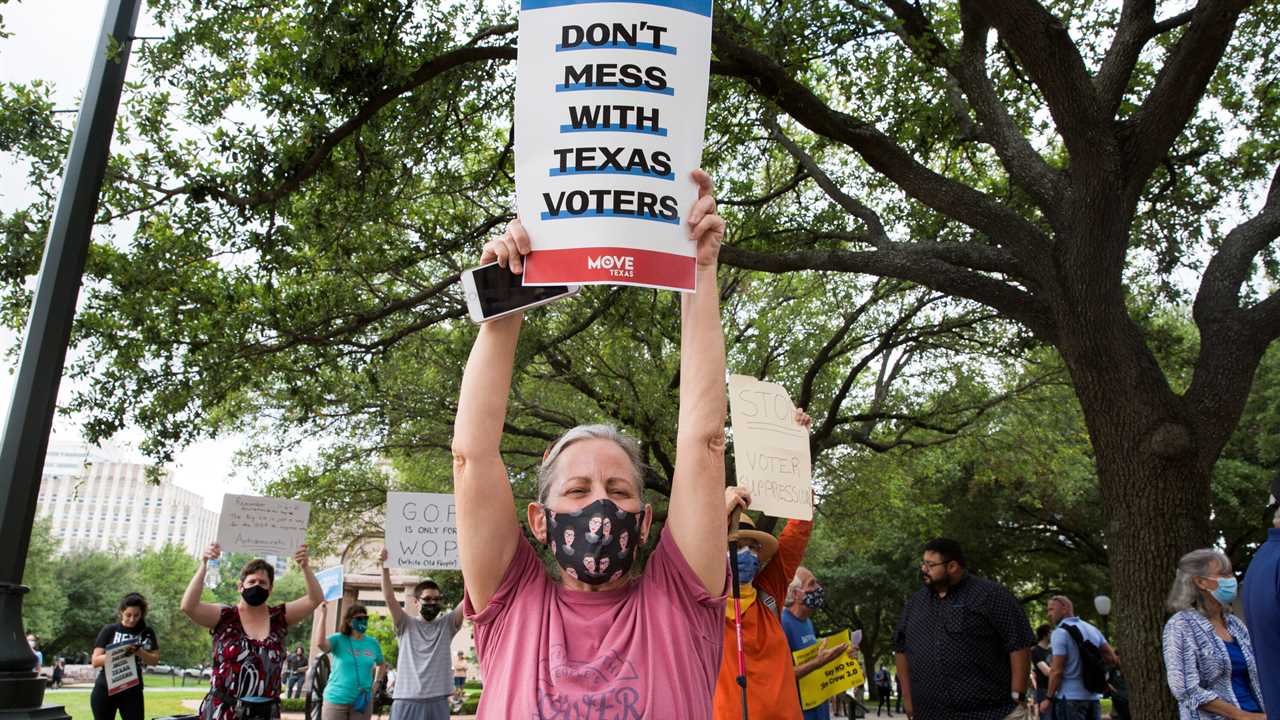
Democrats denounced the dark-of-night legislative maneuver on a measure that Senator Borris L. Miles, a Democrat from Houston, said people in his largely Black and Latino district called “Jim Crow 2.0.”
“They do ask me, every time I’m in the neighborhood, is this 2021 or is this 1961?” Mr. Miles said on the Senate floor. “And why are we allowing people to roll back the hands of time?”
The House, which did not move to suspend the 24-hour rule, is set to convene at 1 p.m. local time, and will debate the bill before voting on it. No further changes to the legislation can be made. Gov. Greg Abbott, a Republican, is widely expected to sign the bill.
Texas is one of several Republican-led states — including Iowa, Georgia and Florida — that have moved since the 2020 presidential contest to pass new laws governing elections and restricting voting. The impetus is both Republicans’ desire to appease their base, much of which continues to believe former President Donald J. Trump’s lies about a stolen election, and the party’s worries about a changing electorate that could threaten the G.O.P.’s longtime grip on power in places like Texas, the second-biggest state in the country.
In a statement on Saturday, President Biden called the proposed law, along with similar measures in Georgia and Florida, “an assault on democracy” that disproportionately targeted “Black and Brown Americans.” He called on lawmakers to address the issue by passing Democratic voting bills that are pending in Congress.
“It’s wrong and un-American,” Mr. Biden said. “In the 21st century, we should be making it easier, not harder, for every eligible voter to vote.”
Republican state lawmakers have often cited voters’ worries about election fraud — fears stoked by Mr. Trump, other Republicans and the conservative media — to justify new voting restrictions, despite the fact that there has been no evidence of widespread fraud in recent American elections.
And in their election push, Republicans have powered past the objections of Democrats, voting rights groups and major corporations. Companies like American Airlines, Dell Technologies and Microsoft spoke out against the Texas legislation soon after the bill was introduced, but the pressure has been largely ineffective so far.
The final 67-page bill, known as S.B. 7, proved to be an amalgamation of two omnibus voting bills that had worked their way through the state’s Legislature. It included many of the provisions originally introduced by Republicans, but lawmakers dropped some of the most stringent ones, like a regulation on the allocation of voting machines that would have led to the closure of polling places in communities of color and a measure that would have permitted partisan poll watchers to record the voting process on video.
Still, the bill includes a provision that could make overturning an election easier. Texas election law had stated that reversing the results of an election because of fraud accusations required proving that illicit votes had actually resulted in a wrongful victory. If the bill passes, the number of fraudulent votes required to do so would simply need to be equal to the winning vote differential; it would not matter for whom the fraudulent votes had been cast.
Democrats and voting rights groups were quick to condemn the bill.
“S.B. 7 is a ruthless piece of legislation,” said Sarah Labowitz, the policy and advocacy director at the American Civil Liberties Union of Texas. “It targets voters of color and voters with disabilities, in a state that’s already the most difficult place to vote in the country.”
But Republicans celebrated the proposed law and bristled at the criticism from Mr. Biden and others.
“As the White House and national Democrats work together to minimize election integrity, the Texas Legislature continues to fight for accessible and secure elections,” State Senator Bryan Hughes, one of the bill’s sponsors, said in a statement. “In Texas, we do not bend to headlines, corporate virtue signaling, or suppression of election integrity, even if it comes from the president of the United States.”
The bill took its final form after a contentious, monthslong debate; back-room negotiations; procedural errors by legislators; and extended, passionate debate by Democrats, who have tried to stall the bill’s passage through political and legislative maneuvers.
>
Voting rights groups have long pointed to Texas as one of the hardest states in the country for voters to cast ballots. One recent study by Northern Illinois University ranked Texas last in an index measuring the difficulty of voting. The report cited a host of factors, including Texas’ in-person voter registration deadline 30 days before Election Day, a drastic reduction of polling stations in some parts of the state, strict voter identification laws, a limited and onerous absentee voting process, and a lack of early voting options.
In the preamble to the new bill, the authors appear to pre-emptively defend the legislation from criticism, stating that “reforms to the election laws of this state made by this Act are not intended to impair the right of free suffrage guaranteed to the people of Texas by the United States and Texas Constitutions, but are enacted solely to prevent fraud in the electoral process and ensure that all legally cast ballots are counted.”
In March, Keith Ingram, the director of elections in the Texas secretary of state’s office, testified that last year’s election in the state had been “smooth and secure.” He added, “Texans can be justifiably proud of the hard work and creativity shown by local county elections officials.”
A day before the Texas bill emerged, a new report pointed to the vast sweep of Republicans’ nationwide effort to restrict voting.
As of May 14, lawmakers had passed 22 new laws in 14 states to make the process of voting more difficult, according to the report by the Brennan Center for Justice, a research institute.